In the first part of this article, we presented how Donald Trump's unpredictable and — at first glance — chaotic tariff policy became a tool for pressure and redefinition of global trade, generating strategic tensions, but also forcing a revision of the current model of globalization.
The legacy of the 1990s: the exodus of industry and the decline of skills
To understand today's debate about tariffs and the return of manufacturing to the United States, it's important to recall the great industrial exodus that occurred in the 1980s and 1990s as part of sweeping trade liberalization and globalization. At that time, many large American companies—especially in the textile, electronics, automotive, and consumer goods industries—decided to relocate production to Mexico, China, Southeast Asia, and Latin America. The reasons were simple and purely economic: lower labor costs, reduced regulatory burdens, growing logistics capabilities, and increasingly open markets.
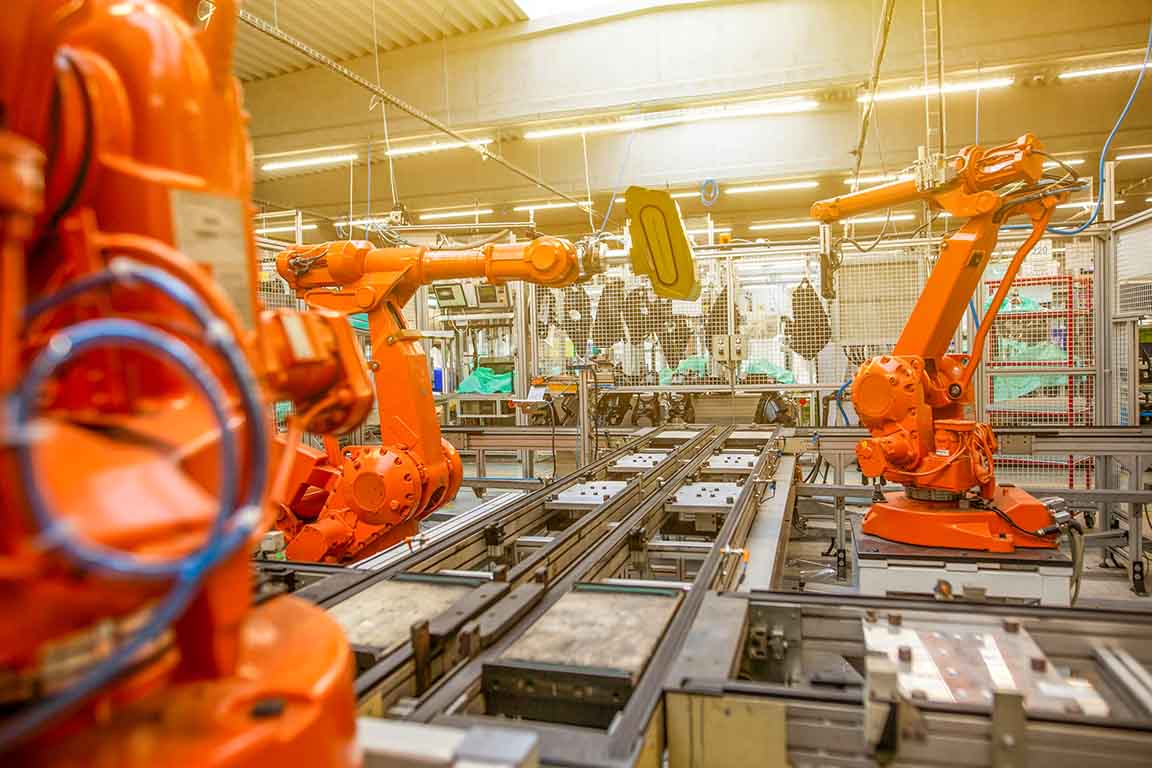
Photo by Simon Kadula (Źródło: Unsplash)
The scale of this process was so large that it began to change the structure of the American labor market. Factories closed, and entire regions—especially in the Midwest—underwent a painful transformation. Stable, well-paid industrial jobs were replaced by jobs with lower prestige, lower pay, and fewer opportunities for advancement. Public discourse began to refer to the "Rust Belt" as a symbol of America's deindustrialization. For some families who had lived off industrial production for generations, this was a moment of lasting change. Many workers moved into service jobs, while others disappeared from the labor market.
This process had another, less frequently reported, consequence: the disappearance of certain skill categories. When entire industries close, not only jobs disappear—so does the infrastructure of skills built over decades: master craftsmen, skilled machine operators, experienced technicians, even local vocational schools and supplier networks. This is a problem also known in Europe—once skills are lost, they are extremely difficult to rebuild.
Reindustrialization and the reality of the 21st century
Against this backdrop, the return of manufacturing to the US—a process that's starting to emerge in investment data—doesn't necessarily mean a return of jobs on the scale of the 20th century. Modern factories are highly automated, powered by robotics, artificial intelligence, and logistics systems that eliminate much of the manual work once performed by thousands of workers.
In modern production:
- there are more engineers, system operators and data analysts,
- fewer – classic assembly line workers,
- supervisory and control tasks dominate,
- work culture is based on the flow of information, not on physical work.
As a result, the return of large corporations to the US may create fewer jobs than in the past and, at the same time pose, new challenges: where to get highly skilled workers when a large part of industrial skills has disappeared during three decades of globalization?
This is the paradox of reindustrialization: even as companies build factories again in America, they won't necessarily be in the same industries or offer the same conditions that created the middle class in the 1950s–1980s. Automation and artificial intelligence are shifting the burden of labor from manual tasks to technological oversight. At every stage, it's clear that today's industry requires different skills, different education, and a different social infrastructure.
Therefore, the debate on tariffs and the return of production cannot be limited solely to the balance of trade. It is also about rebuilding the ecosystem of skills, without which no large economy can sustainably function. This challenge goes far beyond customs decisions and touches on a fundamental question: how can we restore the country's industrial potential, which has been lost not only in economic structures but also in awareness and work culture?
The lasting effects of the "China Shock": industry is coming back, but workers are not
According to The Wall Street Journal, the effects of the so-called "China Shock"—a sharp increase in imports of cheaper goods from China following its accession to the WTO—are still being felt today. Although production is returning in some cities in a new form and investment is emerging, the situation of workers has not recovered proportionally.
The WSJ report highlights three phenomena:
- Some former workers never returned to the job market, often due to permanent loss of qualifications or health deterioration.
- There are fewer new jobs than those lost and they require different skills.
- Income inequality remains, even where local economies are beginning to recover.
This means that simply returning manufacturing to the US doesn't equate to rebuilding the middle class. Some cities are seeing increased investment, but without rebuilding local job ecosystems—vocational schools, suppliers, micro-enterprises—returning to the state of affairs 30 years ago is impossible.
The “China Shock” was therefore more than just a one-off disruption – it was a structural breakthrough, after which the labor market underwent an irreversible change on a regional scale.
The Impact of AI on Reindustrialization: An Industry Without Workers?
A 2023 McKinsey Global Institute report notes that the development of generative artificial intelligence is radically changing the way companies operate and the labor market in the US. In the context of modern reindustrialization, this means that factories are coming back, but people are not necessarily coming back to factories.
According to McKinsey:
- Automation is encompassing more and more mental tasks, not just physical ones.
- Generative AI systems are taking over some design, logistics, and control tasks.
- Factories run by new investors are being designed in an "AI-native" manner: from the outset, they aim to minimize manual work.
In other words, 21st-century reindustrialization requires fewer workers and, at the same time, higher levels of qualifications. This means that:
- cities can regain their plants,
- the state can regain production,
- but the society will not fully regain its former employment structures.
Moreover, without investment in vocational and engineering education and skills development, AI may not so much restore jobs as create a new skills gap, which would become the biggest challenge of reindustrialization.
This fits into a broader diagnosis: the era of globalization has reduced the number of technical specialists, and the era of artificial intelligence could exacerbate this problem if it isn't supported by appropriate educational and industrial policies. Even if it does, it's a decades-long program.
Regional impacts of tariffs: the return of geographic inequalities
Current US tariffs, according to a Reuters analysis based on data from the Federal Reserve in Richmond, are not hitting the US economy evenly. They are being felt most acutely in the Midwest and Southeast. These are regions that were historically heavily industrialized and then suffered severely during the deindustrialization of the 1990s.
These are also areas where supply chains are more physical: they consist of steel mills, auto parts factories, machinery manufacturing, and metal processing. Tariffs on imported components—especially from Asia—often raise costs for local companies more than for coastal companies whose business models rely on services, finance, or technology.
This is leading to a re-creation of the US economic map, where the costs of federal policies are distributed asymmetrically. In practice, this means that the entire burden of "tariff wars" may fall on the shoulders of regions that were once symbols of America's industrial might—and are now most vulnerable to shocks in global trade.
From a political perspective, this is not without significance: it is in these states that the most heated disputes about the future of the economy, jobs and the role of the state in reindustrialization are taking place.
The EU's position: between US pressure and Asian expansion
Europe finds itself in a completely different situation than in previous decades. Until now, it could function as an economic partner to the US while simultaneously benefiting from cheap Asian production. Today, this balance has been disrupted.
The EU faces three challenges:
- The US is also imposing tariffs on European products – something that would have been unthinkable in an alliance relationship just a dozen years ago.
- China has become a leader in strategic industries, such as batteries, solar panels, industrial machinery, and electronic components.
- The European automotive industry is under pressure – both from global competition and the costs of energy transformation.
Brussels, Berlin and Paris are therefore directing more and more efforts towards:
- protecting the European market against price dumping,
- creating joint industrial programs,
- regaining control over the production of semiconductors and critical technologies.
As a result, Europe, like the US, is beginning to move away from the strict economic liberalism that has dominated since the 1990s. This clash of free trade ideology with the new geopolitical reality will be one of the most important economic processes of the coming years.
China: An Alternative Model of Globalization?
Against the backdrop of America's realignment, China's role as a promoter of its own vision of globalization is growing. China—linked to the global economy through a network of investments, exports, credit, and supply chains—can and wants to present itself as a stable, predictable, and commercially open country.
The Middle Kingdom:
- implements an extensive industrial policy,
- invests in technology and self-sufficiency,
- strives to reduce dependence on foreign suppliers of chips and machines,
- simultaneously develops infrastructure projects (e.g. Belt and Road),
- builds economic influence zones in Asia, Africa and Latin America.
For the world, this means a system of two economic models that are increasingly difficult to reconcile within a single global system:
- the liberal model (USA, EU),
- and the model of state capitalism (China).
Tariff wars are therefore just one symptom of a deeper struggle over the shape of globalization.
Global Order After the Tariff Wars: A New Balance of Power
Tariff wars challenge the basic assumptions on which global trade has been based since the end of the Cold War, namely:
- free movement of goods,
- primacy of international organizations,
- abolition of barriers and tariffs,
- trust between partners.
Today's countries—whether the US, China, the EU, India, Brazil, or South Korea—are increasingly committed to the principle that trade is not an abstract ideology, but a tool for advancing national interests. This means that:
- barriers are returning,
- export controls are increasing,
- supply chains are fragmenting,
- and globalization is no longer a one-way process.
We may be entering an era of "bloc globalization"—a world divided into several economic zones competing with each other both commercially and technologically.
In this world, "middle powers"—such as Japan, South Korea, India, and EU countries—are being courted by both major players. Each tries to attract allies by offering access to technology, markets, and capital.
The tariff game as a tool of political pressure
The big question remains: what does Trump's tariff policy really mean?
- In the technical sense, tariffs are an economic instrument.
- In the political sense, they are a tool for exerting pressure, testing partners, and forcing new arrangements.
Tariffs, as interpreted by Trump, serve a function that goes beyond the trade bill:
- they are an instrument of negotiation,
- a tool for putting pressure on allies,
- a signal for competitors,
- a bargaining chip in diplomatic relations,
- an element of the election campaign,
- a symbol of the reversal of globalization trends,
- an attempt to rebuild the importance of the nation state in the economy.
Will these actions bring the promised results?
Final conclusions: between history and the uncertainty of tomorrow
It's difficult to assess where the tariff wars launched by Donald Trump will ultimately lead, and which—regardless of the White House's occupant—have become a permanent part of American economic strategy. One thing is certain: the world is returning to power politics, including in the economy, and the era of unquestioned globalization, so characteristic of the 1990s and early 21st century, is a thing of the past.
In this new order, each country is attempting to redefine its own interests. The US seeks to regain control over industry and critical technologies; China is building an alternative architecture of global connections; Europe is seeking ways to defend its technological advantage while simultaneously maintaining domestic economic stability. At the intersection of these ambitions, a world is emerging that is more divided, yet also more dynamic than before.
Tariffs, intended as a tool for negotiation or pressure, have become a symbol of an era of revaluation. They demonstrate that no country—even the most powerful—remains indifferent to the effects of globalization, which have shattered many social and economic structures from within.
However, there's no point in deluding ourselves into thinking that bringing manufacturing back home will solve the problems of past decades. The 21st-century industry is nothing like it was thirty years ago—it's automated, based on artificial intelligence, capital-intensive, and requires skills that many societies have yet to learn. This means that even the best economic instruments must be linked to educational, social, and regional policies.
In this situation, the question of goal effectiveness is not a technical one, but a civilizational one. Can Western countries rebuild their industrial and technological potential? Can they create conditions for the advancement of the middle classes, which for years were the engine of growth? Will they be able to find a place in a world where competition no longer revolves around goods, but rather innovation, data, and production capacity?
The answers are unclear today. One thing, however, seems certain: the world will not return to the order of yesteryear. Geopolitics, technology, and the growing ambitions of states are creating a new era—more demanding, more conflictual, but also more open to change. In such times, historical analogies must give way to reflection on the reality in which economic decisions become a tool of politics, and politics a test for entire societies.